Category: Artificial Intelligence

content
January 9, 2021
Machine learning and infrared thermal imaging in breast cancer detection
January 9, 2021

Cancer is the most important public health issue in the world and breast cancer is the most commonly cancer type detected in American women. Breast cancer is the second type more common cancers in the world and is more widespread among women.

Over the past 20 years, many applications have been found in the medical profession for early detection of breast cancer such as mammography which is often used for breast cancer diagnosis.

However, the potential side effects of using mammography and the rate of false positives discourages patients and physicians to use this method. Moreover, mammography has some limitations such as the difficulty of detecting tumors in young patients or cancers without masses, such as Paget’s carcinoma. Since the young breast is mainly composed of glandular tissue, which makes it denser, this high density of the breast interferes in the identification of masses and micro-calcifications by X-rays.

Infrared thermography (IRT) is another technique that has been used in combination with other screening techniques in the aid of breast cancer detection. This method is:

  • A low-cost technique that does not involve harmful radiation to humans
  • It does not involve invasive procedures
  • It is based on the principle of measuring the infrared radiation emitted by an object or surface through an infrared camera to determine its temperature
  • It may provide better results for breast cancer detection in young women, who usually have denser breasts, when compared to mammography

The approach proposed in this article: Gonçalves, C.B; Leles, A.C.Q.; Oliveira, L.E.; Guimaraes, G.; Cunha, J.R.; Fernandes, H. Machine Learning and Infrared Thermography for Breast Cancer Detection. Proceedings 2019, 27, 45 involves the acquisition of infrared images of healthy patients and patients with cancer followed by the extraction of features to describe these images.

Database

The database used contains data from 70 patients with or without breast tumor. These images were collected in a five-month period. The images were captured with a mid-wave infrared camera.

Images were acquired using the static protocol:

  • Patient waited 15 minutes for acclimatization of body temperature
  • The image acquisition was performed

(Images, from each patient, were acquired in four different poses:

  • front with arms raised
  • front with arms down
  • left side (left breast only)
  • right side (right breast only)

For the analyzes performed in this work, only the frontal images with the raised arms were considered since the images in the other positions were not standardized.

The patients were classified into three groups

  • Normal (without changes)
  • Benign changes (benign nodules)
  • Malignant changes (tumors)

The patients were only submitted to the necessary examinations so that the specialist doctor had the conclusive and final diagnosis.

Experiment

Two classifiers were considered:

  • Artificial Neural Networks (ANN)
  • Support Vector Machine (SVM)

Experiments were performed with three different input images. For the first one no spatial filter was applied in the images. In the second the median filter was applied while in the third a Gaussian filter with σ=2 was applied. Based on the features presented in Section 2, seven different feature combination were tested. The choice of these combinations was made based on what was presented in [3,7,8]. Feature combination are going to be presented in details in the extended version of the paper: Gonçalves, C.B; Leles, A.C.Q.; Oliveira, L.E.; Guimaraes, G.; Cunha, J.R.; Fernandes, H. Machine Learning and Infrared Thermography for Breast Cancer Detection. Proceedings 2019, 27, 45.

Results

The best result obtained with the ANN was achieved with 15 neurons in the hidden layer, considering the feature combination number. This setup had an accuracy of 76.19%, a normal specificity of 57.1%, a benign specificity of 83.3%, and a malignant sensitivity of87.5%.

For the SVM, the best result was also achieved by using the feature combination number 5. This setup had an accuracy of 80.95%, a normal specificity of 83.33%, a benign specificity of 85.71%, and a malignant sensitivity of 75%.

Conclusions

The use of infrared images for the detection of breast cancer is a promising screening technique which can aid in the diagnostic of the disease since it is a pain-free technique, can identify changes in dense breasts (which is hard for the conventional mammography), there is no harmful radiation, can identify early changes, and has a low cost.

Our results are promising and confirm that infrared images can be used for breast cancer detection. Gonçalves, C.B; Leles, A.C.Q.; Oliveira, L.E.; Guimaraes, G.; Cunha, J.R.; Fernandes, H. Machine Learning and Infrared Thermography for Breast Cancer Detection. Proceedings 2019, 27, 45.

AI Talos is an AI-powered software reinventing how thermographers all around the world can detect breast cancer using deep learning and thermal imaging methods, for more information please visit our website at www.aitalos.com or have a look at our LinkedIn public page at:   https://www.linkedin.com/company/ai-talos
content
January 3, 2021
Breast Cancer Detection Using Infrared Thermal Imaging and a Deep Learning Model
January 3, 2021

One of the most common diseases that play a leading role in the death of women is breast cancer. The early and precise diagnosis of breast cancer plays a pivotal role to improve the prognosis of patients with this disease. According to many studies and extensive researches, such abnormalities can be detected and treated at primary stages of the disease making sure that highly accurate and precise techniques and soft-wares are used. Over the past 20 years, many applications have been found in the medical profession for thermal imaging such as mammography which is often used for breast cancer diagnosis. However, the potential side effects of using mammography and the rate of false positives discourages patients and physicians to use this method. In this article we focus on diagnosing breast cancer using medical imaging techniques through state-of-the-art artificial deep neural network approaches.

Previous Studies

From 2002-2010 several researchers have explored the limitations of mammography as a screening tool for detection of breast cancer. Despite the preference for mammography for the past several decades, the need for new techniques to overcome the limitations of mammography as a technique has emerged. Hence, some others focused on the neural network modalities and other innovative techniques for solving the problem of breast cancer.

Breast Cancer Detection Using Infrared Thermal Imaging

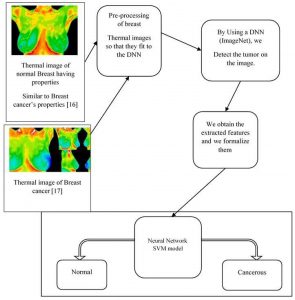
As we know, the sooner the anomaly is found, and the sooner treatment is consequently begun, and the better the chances of success. Moreover, it is important to highlight that the image processing has a powerful NIRF light signal, so that the image taken contains a lot of information that is very close to the actual state of the breast. Through the review of the articles, we found out the importance of image processing, which is currently performed well by a human being but which is not yet adequate when performed by artificial intelligence methods. This highlights the need for a Computer Assist Device (CAD) that will help us to better understand the thermal images captured by our different thermal imaging cameras. In this context a CAD will be a deep neural network with an SVM model as a classifier, as shown in Figure 10 (assuming it is already trained) that will take the thermal images in, and as output classify the images as containing cancer or not. We should clarify that the deep learning module will output the probability of a breast’s thermal image being classified as sick (having cancer) or healthy (without cancer).

Figure 10. Illustration of our model

Why using a new model?

In section 2, we outlined previous and new techniques used for the detection and prevention of breast cancer. The model that we present in this paper takes advantage of two main factors:

  • It uses a deep neural network which is modified at the last fully connected layer in such a way as to obtain a powerful binary classification (sick breast or healthy breast).
  • A second well known classifier (SVM) is coupled to that, and is involved only in the case of an uncertainty in the output of the DNN.

Conclusion

Reviewing the article, it is obvious that work in the area of breast cancer detection from a computer scientist point of view could be a valuable contribution to the field. With this in mind, we presented the techniques most commonly used to detect breast cancer, and their strengths and weaknesses. One technique in particular appeared to have a promising future, because of its non-immersive property and the significant amount of data that needs to be processed with more efficient techniques. Infrared imaging coupled with an agent previously administered to a patient can lead to a very accurate tumor detector.


References:

Mambou, S.J.; Maresova, P.; Krejcar, O.; Selamat, A.; Kuca, K. Breast Cancer Detection Using Infrared Thermal Imaging and a Deep Learning Model. Sensors 2018, 18, 2799.

zaf3r
December 8, 2020
Artificial Intelligence As A Diagnostic Tool In Breast Cancer Thermography
December 8, 2020

One of the most common diseases that play a leading role in the death of women is breast cancer which is very difficult for countries’ healthcare system to treat, specifically in its advanced stages.

In the past, the temperature of human body was used as a health diagnostic tool. Warm blood flows in human body that produces heat. Respective changes in the temperature of the inner part of human body can be regarded as probable illnesses. Since 17th century thermometers were used as a tool to observe the temperature of the body. This procedure is known as Thermogulation. Scientists such as George Martin and Carl Wundelich stated that temperature of the body is a scientific criteria for diagnosing diseases. The normal body temperature is between 36.3 C to 37.5 C and any degrees out of this range is viewed as a symptom of diseases. In 1800, a new world appeared in the field of Thermography, infrared light was discovered by William Herschel and his son John Herschel recorded the first thermal images. Hardy in 1934 proposed that: “Human skin can be considered as a black body radiator”. He studied diagnostic tools in clinical science using infrared Thermography observations.


Thermography in clinical science

Although thermal imaging is not definite and surroundings can affect its results, but by using thermal images irregular thermal patterns can be easily recognized. Reasons why thermal imaging is wide-accepted among the medical community is listed below:

  • Thermal imaging is non-contact and non-invasive
  • The method can be used from far way
  • It’s possible to simultaneously monitor a large area of the population
  • Interpretation of thermogram’s colors is easy and fast.
  • This method only records natural radiation from the surface of the skin and there is no trace of harmful rays, so is suitable for long-term and repeating use.
  • Finally Thermography is a fast way to monitor and observe the dynamic changes in temperature.

Due to these merits, Thermography is an effective replaced diagnostic tool.

Thermography as a diagnostic tool for Breast Cancer

Thermography has many distinctive features. Some of them are listed in the following paragraph:

  • The ability for early diagnosis of cancer by detecting early signs of cancer, ten years earlier than mammography
  • Predicting the future state of the patient
  • Independence to the age of the patient and the density of breast tissue
  • Detecting symptoms of breast cancer 1 year earlier than mammography

In contrast, the lack of specialized knowledge to observe and poring over the results of Thermography is the vital feature that reduces its quality in comparison with other methods such as CBE, mammography and biopsy.

Artificial Intelligence in Breast Cancer Thermography

In 1960s, there was a strong tendency for replacing computers with physicians. However, at that time computers were not developed yet and modern digital images didn’t exist. These were the problems that caused the computer’s failure for detecting the abnormalities. In 1980s, despite of the failure in the 1960s, scientists used this approach to assist physicians in order to identify the abnormal areas and also provide a second opinion beside doctor’s detection. The approach is called Computer Assisted Diagnosis (CAD) and it is well-accepted all around the World. This approach (CAD) didn’t attempt to replace physicians with computers but it helped them to reach a more reliable way of diagnosis. From 1977 to 2015, several outstanding CAD systems in Thermography have been made. Even in 2002, with images taken from the camera of the second generation and the use of recurrent neural networks, the percentage of accuracy was the biggest challenge. In recent years, due to developments in image processing techniques, Sensitivity and Specificity in Thermography has been able to achieve more than other methods such as mammography. With production and advancement of neural networks and also introducing systems based on fuzzy logic and as well as the high quality of the Thermograms as a result of the second generation of cameras, Thermography systems (CAD) draw attention of many researchers.

Restrictions of Thermography as a diagnostic tool

There are some restrictions that restrict the ability of Thermography in diagnosis of abnormal states of breast tissue. Since this method is a thermal imaging of skin’s surface, it cannot detect a region or tumor. The interpretation of Thermography images depends on the identifying regions with high temperature, low metabolic function, or cold tumor, which is very challenging. According to a study about function of Thermography in 2003, it was found that all of the false-negative results of Thermography have been related on tumors on micro size; Which suggests that Thermography is not as accurate as mammography in detecting these abnormal states.

References:

Ahmad Ghafarpour1, Iman Zare1, Hossein Ghayoumi Zadeh2*, Javad Haddadnia3, Farinaz Joneidi Shariat Zadeh4, Zahra Eyvazi Zadeh4, Sogol Kianersi4, Sogol Masoumzadeh4 and Shirin Nour (2016). ‘A review of the dedicated studies to breast cancer diagnosis by thermal imaging in the fields of medical and artificial intelligence sciences’, Biomedical Research (2016) Volume 27, Issue 2
This website uses cookies to improve your experience. Cookie Policy